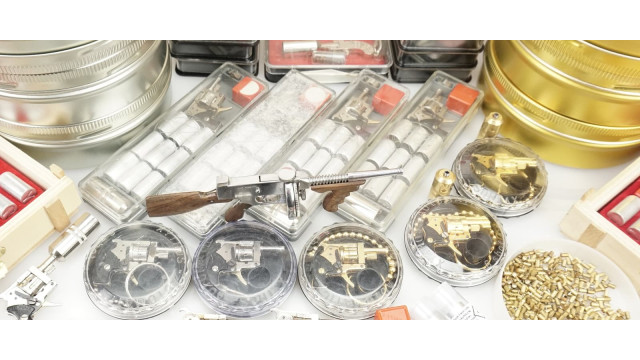
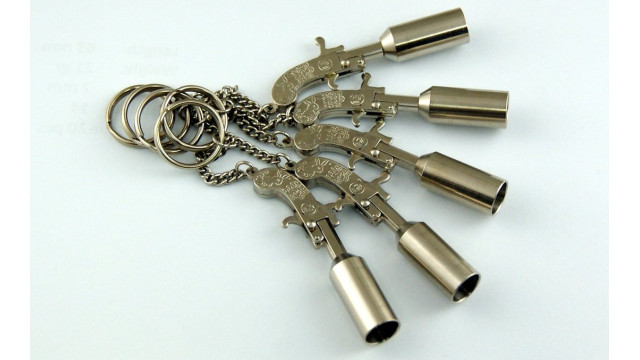
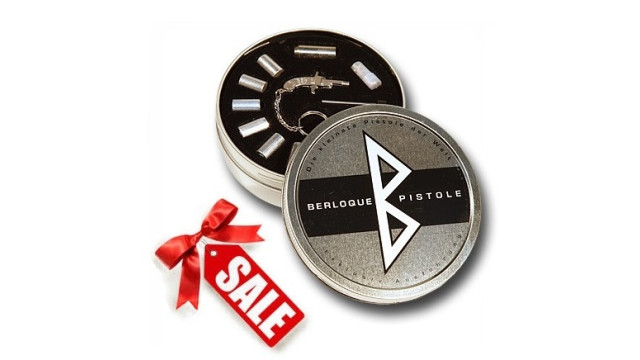
Berloque Miniature Pinfire Guns: Origins, Design, and Historical Editions
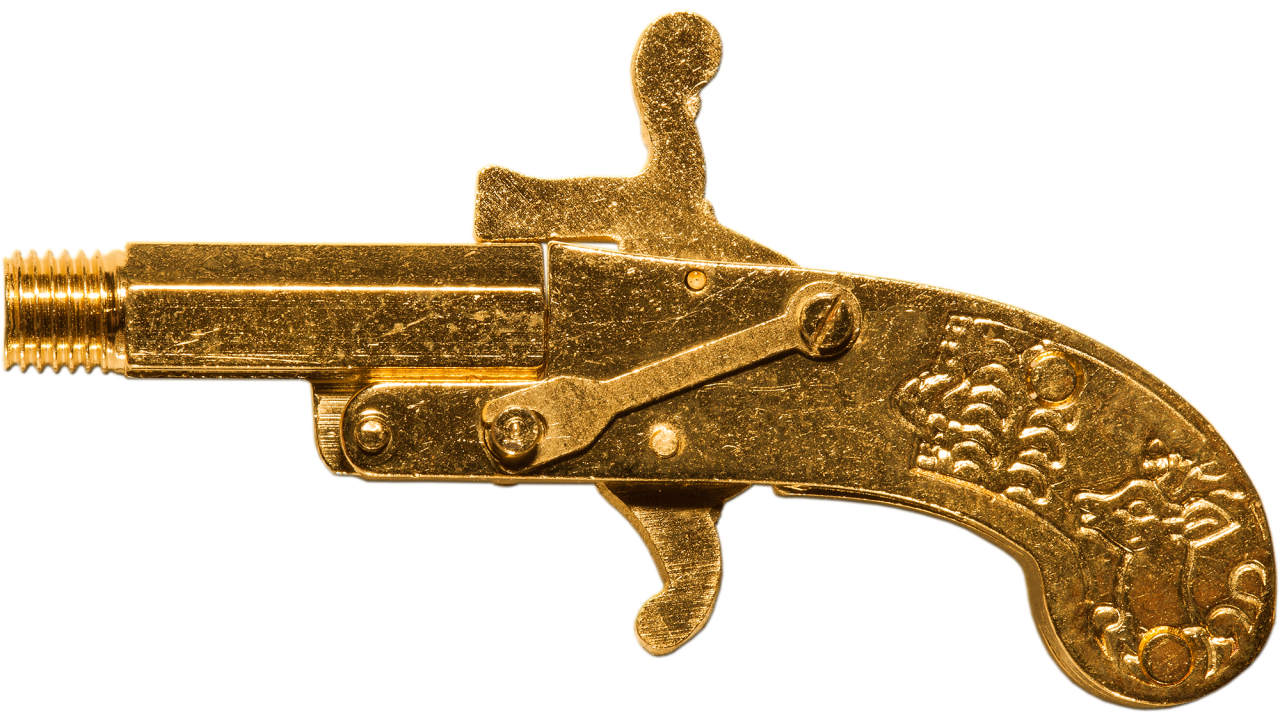
The Berloque miniature pinfire pistol is one of the most recognizable objects in the history of miniature mechanical collecting. With its abbreviated barrel, curved ornamental grip and characteristic attachment ring, it resembles a pocket pistol reduced to the scale of a charm.
The name has become familiar far beyond one particular maker or period. Yet the historical Berloque story is best understood through Austrian watchmaking, Franz Pfannl's early design, later manufacturers and the surviving evidence of individual examples.
Austrian origins and Franz Pfannl
Franz Pfannl, an Austrian watchmaker, is widely credited with developing the early Berloque watch-fob pistol. The Miniature Engineering Craftsmanship Museum states that he began making these miniature pistols in 1897. Separately, a documented patent dated 24 July 1899 describes a compact pistol intended to be worn with jewelry or a watch chain.
The connection with watchmaking helps explain the concept. Rather than simply shrinking the appearance of a full-size gun, the design had to be an identifiable ornament, mechanically interesting and suitable for very small-scale manufacture.
It also offered an alternative to the more intricate-and often more expensive-miniature revolvers produced as specialized curiosities during the preceding decades.
Why the name "Berloque" is important
In historical descriptions, Berloque and the related spelling Breloque are encountered in connection with small charm or fob pistols. Spelling and usage vary across languages and catalogues.
Over time, the term came to be used quite broadly for this style of tiny pistol. Consequently, a listing labeled "Berloque" does not by itself establish that the item was manufactured by Pfannl in the 1890s.
The collector's more useful questions are: Is the object an early Austrian example, a later Austrian production piece, an overseas variation or a modern reproduction? What markings and documents support that identification?
The distinctive Berloque silhouette
Classic Berloque-style pistols are notable for a handful of visual characteristics:
- Very compact proportions: Often only a few centimeters long, though dimensions differ by maker and edition.
- Curved grip: Frequently decorated with scrollwork or another repeated ornamental motif.
- Single-shot profile: The most familiar watch-fob pattern does not have the cylinder of a miniature revolver.
- Small suspension loop: A ring or attachment point reflects the original watch-chain or charm concept.
- Metallic finishes: Collectors encounter plain, nickel-colored and other decorative variants, but finish descriptions require specimen-level verification.
These features describe a design tradition, not a checklist guaranteeing authenticity. Some later look-alikes borrowed the silhouette, and some models differ substantially in construction.
Early catalogues and wider production
Miniature watch-fob pistols reached an international audience in the early 20th century. Research by Aaron Newcomer documents a miniature pistol in the 1903 Sears catalogue and decorative variants illustrated in a 1911 German commercial catalogue.
The catalogues are important because they show how the miniature was understood in its own time: not only as a mechanism, but as a curiosity, a small gift and a personal accessory. Historically, catalogues sometimes presented these objects as toys. Modern readers should treat that label as historical evidence, not a statement of present-day safety or legal status.
Manufacture also expanded beyond the original Austrian watchmaker. The Miniature Engineering Craftsmanship Museum preserves a 1930s Berloque Pistölchen made by Gerhard Göbharter GmbH in Groß-Siegharts, Austria. This documented object demonstrates why the names of designers and later manufacturers should not be collapsed into one attribution.
What counts as a historical Berloque edition?
The word edition is often used loosely in online listings. Some differences are historical production variants; others are later decorative finishes or retailer descriptions.
For collector documentation, it is useful to distinguish:
Period production examples. Objects demonstrably made during an identifiable historical period, supported by manufacturing marks, original packaging, catalogues or provenance.
Decorative variants. Examples distinguished by grip material, engraving, plating, presentation case or other visible ornament. A gold-colored finish, for example, is not proof of a solid-gold component.
Boxed sets. Examples preserved with their contemporary cases, printed instructions and associated materials. Matching packaging can strengthen an attribution but should be examined for consistency and age.
Later reproductions and reissues. Products made after the period they evoke. These may retain the traditional Berloque appearance without being historical originals.
A confident listing should identify which category applies and avoid phrases such as "first edition" or "limited edition" unless documented.
A Berloque in a museum collection
The Miniature Engineering Craftsmanship Museum describes a Pfannl-made Berloque acquired by its donor as a novelty associated with the 1939 New York World's Fair. The museum also documents a separate boxed 1930s Austrian Berloque example.
These records are useful because they place actual surviving objects into social and commercial contexts. A miniature with a dated story, original packaging and documented origin can reveal much more than its physical dimensions.
How to research a Berloque collectible
Examine the item as a historical artifact. Note its exact dimensions, marks, grip motif, attachment ring, finish and condition. Record what is known about its box and the origin of any paperwork. Compare those facts with museum examples and period illustrations.
Avoid assuming that a decorative pattern gives an exact date or that all Berloque-pattern objects share the same manufacturer. A responsible description can openly say "maker not established" when the evidence is incomplete.
The Berloque legacy
The Berloque survived in collectors' imaginations because it made an industrial-age mechanism into a memorable miniature object. Its story belongs to the history of pinfire technology, but also to the worlds of watch chains, decorative metalworking and popular novelties.
To understand the Berloque fully is to recognize the difference between an original concept, later manufacturing traditions and modern collector terminology. That distinction protects the historical meaning of each surviving example.
Quick questions
Who designed the original Berloque-style miniature? Austrian watchmaker Franz Pfannl is credited with the early design; the museum dates his production to 1897 and a related patent is documented in 1899.
Were all Berloques made by Franz Pfannl? No. Later manufacturers, including Gerhard Göbharter GmbH, produced examples.
What makes a Berloque historically identifiable? A combination of physical characteristics, markings, original packaging, provenance and comparisons with documented examples.