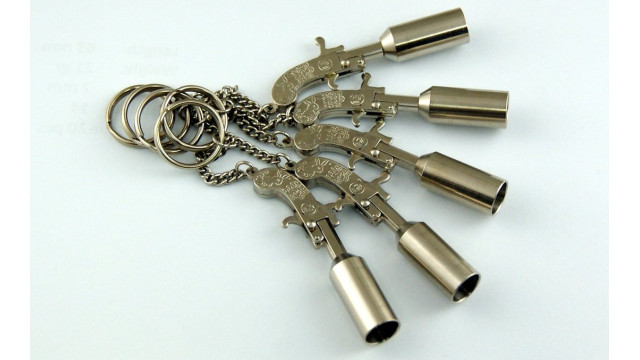
What Is a Miniature Pinfire Gun? History, Design, and Collector Terminology

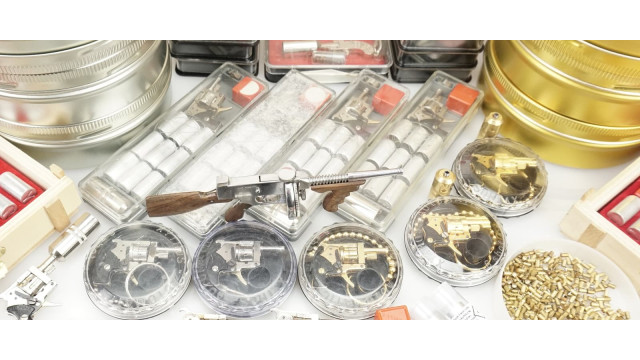
A miniature pinfire gun is a very small firearm-shaped object associated with the historic pinfire ignition system. Depending on the period and model, it may be an antique miniature firearm, a cap-firing novelty, a watch-chain ornament, a modern collector reproduction or a completely non-firing replica. Those differences matter. Two items that look almost identical in a photograph may have very different histories, mechanisms and legal classifications.
The best-known small-format examples are often described as 2mm pinfire guns. They connect a 19th-century cartridge invention with a later European tradition of miniature metalwork, watchmaking and novelty manufacture.
Where does the word "pinfire" come from?
The term refers to a cartridge with a small pin projecting from its side near the base. In a traditional pinfire mechanism, a hammer strikes that pin, which acts upon the primer inside the cartridge. This is what distinguishes the system from later rimfire and centerfire ammunition, where the ignition arrangements are different.
French gunsmith Casimir Lefaucheux patented an important version of the pinfire cartridge system in 1835. His work helped make self-contained ammunition more practical in breech-loading firearms. His son, Eugène Lefaucheux, later developed influential pinfire revolvers. Those full-size 19th-century firearms are the historical foundation of the technology-but they should not be confused with the miniature novelties that became popular decades later.
What does "2mm" mean?
In miniature-pinfire collecting, 2mm is a nominal caliber or format designation used for a family of very small objects and cartridges. It is not a guarantee that every similarly labeled item uses identical ammunition, has the same internal dimensions or works in the same way.
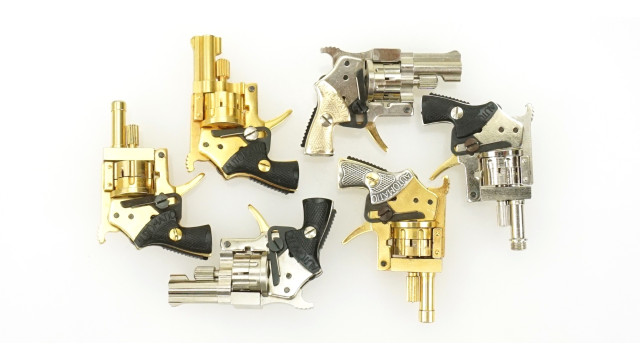
Early miniature revolvers, later single-shot watch-fob pistols and Xythos-style revolvers did not all follow one universal standard. Specialist cartridge research documents physical differences between historical 2mm examples. For identification, collectors should therefore rely on maker markings, credible documentation and model-specific information-not the number "2mm" alone.
How miniature pinfire objects developed
The story has two overlapping chapters. During the late 19th century, craftsmen made very small pinfire revolvers, sometimes as costly demonstrations of mechanical skill. Researcher Aaron Newcomer documents early 2mm cartridge designs associated with French ammunition manufacturer Société Française des Munitions and an 1880s miniature revolver marketed by Victor Bovy.
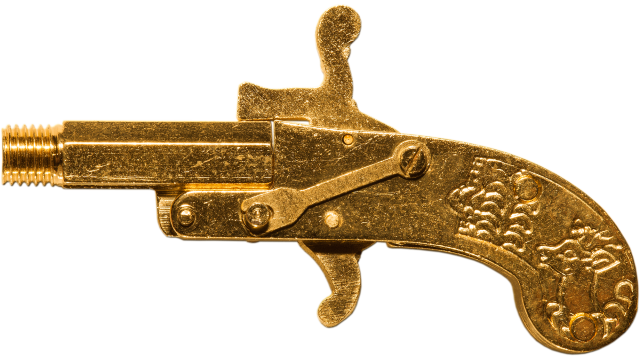
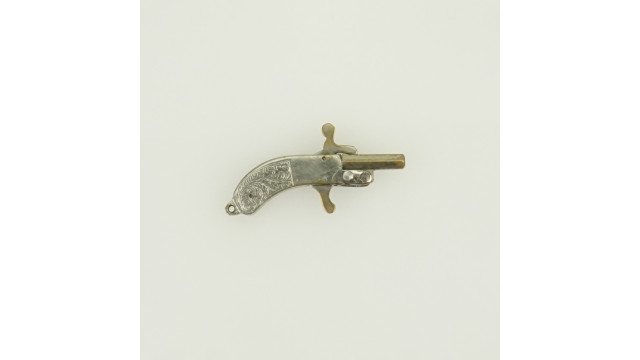
A second chapter began with simpler, more affordable watch-fob and charm pistols. Austrian watchmaker Franz Pfannl is closely associated with this format. The Miniature Engineering Craftsmanship Museum dates his Berloque activity to 1897, while a documented Pfannl patent dates to 1899. These miniature objects later appeared in catalogues, personal accessories and gift presentations in different countries.
By the 20th century, examples carrying names such as Berloque, Maus and Xythos reflected different design families and generations of miniature manufacture.
Basic collector terminology
A few commonly encountered terms make historical descriptions easier to interpret:
- Pinfire: An ignition system characterized by a projecting side pin in the cartridge.
- 2mm pinfire: A broad small-caliber designation; not an automatic compatibility certification.
- Berloque / Breloque: A name strongly associated with the watch-fob miniature pistol tradition. It is sometimes used loosely for similar miniature charm pistols rather than one precisely identified maker.
- Watch fob / key-ring pistol: A miniature designed with a suspension loop or attachment so that it could be worn or carried as an ornament.
- Single-shot miniature: A model with one chamber rather than a rotating multi-chamber cylinder.
- Miniature revolver: A scaled-down revolver-style design with a cylinder; some examples are functional, others non-firing.
- Cap or blank: A term for a cartridge intended primarily to produce a report rather than launch a projectile. Its presence does not make an item harmless.
- Non-firing replica: A display model that reproduces the appearance, and sometimes some movements, of a historic mechanism without being intended to discharge ammunition.
- Original box / provenance: Contemporary packaging or documented ownership history that can help establish authenticity, dating and completeness.
- Finish / plating: The surface treatment of a miniature, such as nickel or gold-colored plating; an ornamental finish is not proof of solid precious-metal construction.
Are miniature pinfire guns toys?
Not as a general category. Some older examples were historically advertised as toys or novelties; some miniature firearms were capable of launching projectiles; other examples were cap-firing devices or inert replicas. Modern legal definitions can differ from historical advertising language and vary by jurisdiction.
The small scale can be misleading. Collectors should regard an unidentified miniature as potentially functional until its status has been reliably established, store it securely and comply with applicable rules. ThePinfire.com identifies its products as intended for adult collectors aged 18 and older, with customers responsible for verifying local restrictions.
What should a collector look at first?
For historical identification, begin with observable facts: overall dimensions, the presence or absence of a cylinder, grip decoration, country-of-origin marks, engraved maker names, apparent finish, original packaging and any surviving documentation. Photograph markings and the object from several angles without attempting to operate or alter an unfamiliar mechanism.
Those details help separate a period-made collectible from a recent reproduction and a genuine miniature revolver from a visually similar non-firing ornament. They also provide a more reliable basis for research than a generic online description.
Why these tiny objects still matter
Miniature pinfire objects reveal how a major 19th-century invention was adapted to the scale of jewelry, personal accessories and precision collectibles. They sit at the intersection of firearms history, decorative metalwork and industrial design.
The most interesting question is often not simply how small is it? but who made it, when, for what audience and with what degree of mechanical fidelity? That is the starting point for understanding this unusual branch of European collecting history.
Quick questions
Who invented pinfire technology? Casimir Lefaucheux is associated with a pivotal pinfire cartridge patent from 1835; miniature 2mm objects came later.
Are all 2mm pinfire miniatures the same? No. Design, age, cartridge specifications and function vary across makers and model families.
Does "Berloque" mean every miniature pinfire gun? No. The word is sometimes used broadly, but identifying a specific maker or edition requires additional evidence.