Berloque, Xythos, and Maus: Understanding Three Miniature Pinfire Traditions
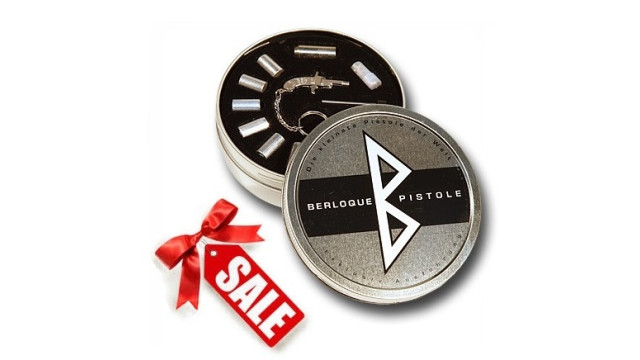
Berloque, Xythos and Maus are three names often encountered in the world of miniature pinfire collecting. They share an association with small-format mechanisms and European novelty craftsmanship, yet they do not describe one interchangeable product or one continuous manufacturing line.
The clearest way to compare them is through their historical origins, characteristic shapes, surviving documentation and collector terminology. That approach is more accurate than assuming that every 2mm miniature has identical dimensions, function or production history.
A quick comparison
| Feature | Berloque | Xythos | Maus |
|---|---|---|---|
| Common visual identity | Tiny watch-fob or charm pistol, usually single-shot in the classic pattern | Miniature revolver with a visible cylinder | German-branded miniature, commonly in a watch-fob-style pistol form |
| Historical association | Austria; early design connected with Franz Pfannl | Austria; revolver-style miniature tradition | Germany; MAUS name appears on surviving packaging |
| Documented historical evidence | Museum cites Pfannl production from 1897; patent identified from 1899; later Austrian boxed examples | Museum documents a 1968 replica copied from an existing Austrian Xythos | Collector research and archived auction document German-made MAUS examples and boxes |
| Typical identification clues | Curved ornate grip, short profile, suspension ring, packaging and maker marks | Cylinder, grip configuration, frame marks, period instructions or case | MAUS branding, German origin marks, grip pattern and matching original box |
| Key caution | "Berloque" can be used generically for similar designs | An Xythos-like object may be a non-firing replica | Exact maker and production dates are not established for every specimen |
This table summarizes documented patterns. Individual objects may depart from them and must be identified on their own evidence.
Their shared origin: the pinfire idea
All three names belong to a story that began before any of these particular miniatures existed. In 1835, French gunsmith Casimir Lefaucheux patented an important pinfire cartridge innovation. The technology later appeared in numerous 19th-century firearms, and by the end of the century it had also found a place in very small mechanical curiosities.
That technological relationship does not mean a direct company lineage. Lefaucheux developed the cartridge principle; subsequent craftsmen and manufacturers adapted small-format designs at different times, often for different audiences.
Berloque: the classic Austrian watch-fob image
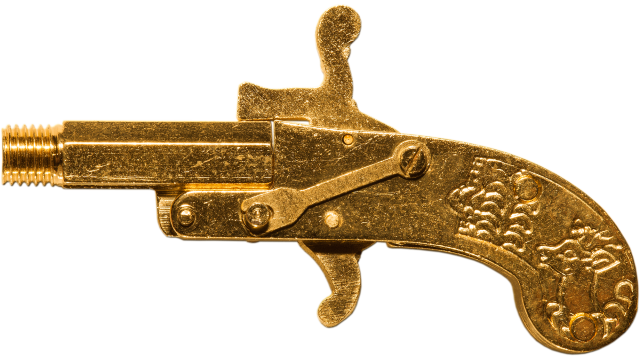
Berloque is the name most closely linked with the familiar miniature charm-pistol silhouette. Austrian watchmaker Franz Pfannl is credited with the early form. Museum records place his production activity in 1897, and a related 1899 patent shows how naturally the object fitted the idea of a jewelry or watch-chain accessory.
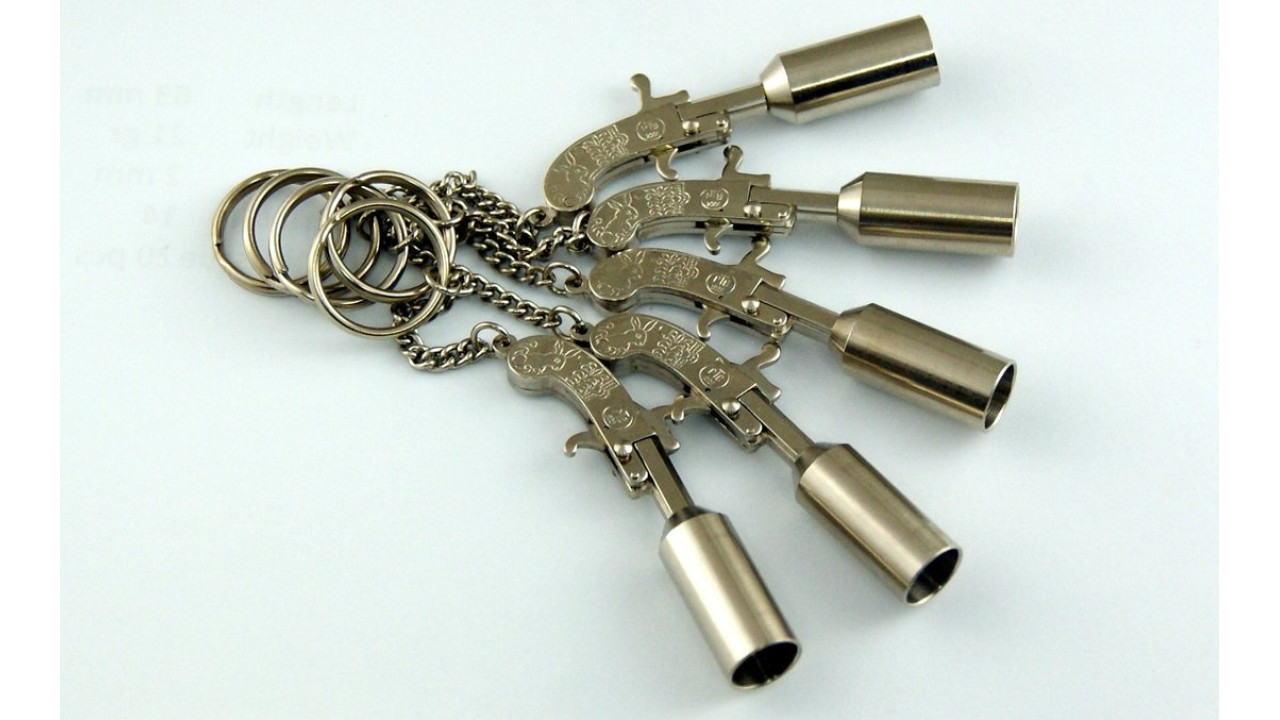
The classic Berloque look is compact and decorative: a curved grip, a short body and a suspension ring. Museum collections preserve later Austrian examples, including a 1930s specimen made by Gerhard Göbharter GmbH.
A crucial distinction is that Berloque can describe a design tradition as well as appear in product names. A Berloque-style pistol is not automatically an early Pfannl original.
Xythos: the miniature revolver identity
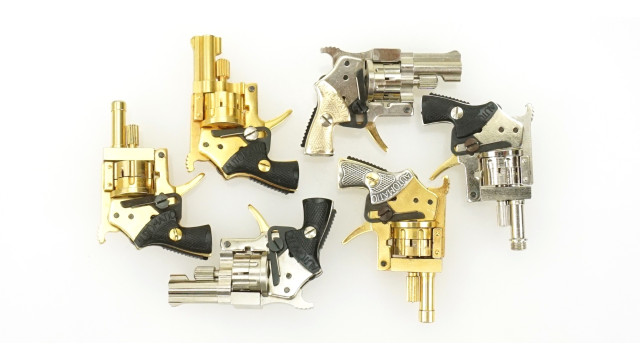
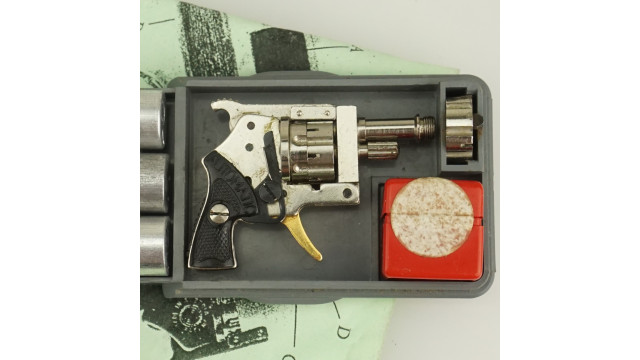
Xythos stands apart primarily because of its recognizable revolver-style outline. The cylinder and grip create a more detailed visual representation of a revolver at miniature scale.
The Miniature Engineering Craftsmanship Museum identifies the original as Austrian and preserves a 1968 non-firing replica by Geof Spehar, copied from an existing real Xythos. This is a valuable historical reference because it clearly distinguishes the original from a later mechanical model built for display.
Austrian company Andres & Dworsky appears in specialist collector research on small-format pinfire cartridges, while separate later patent documentation confirms the company's involvement in miniature pistol designs. Neither fact should be overstated as a precise date of first Xythos production.
Maus: a German-branded charm-pistol tradition
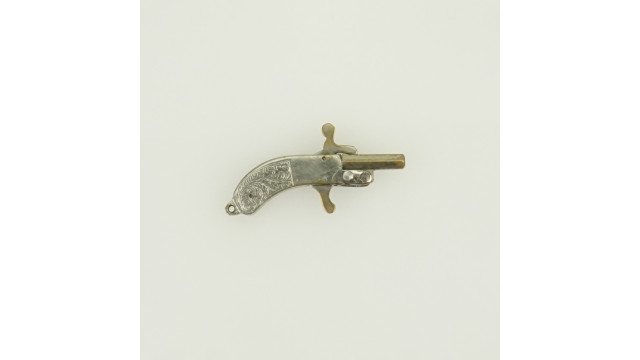
Maus means mouse in German. It appears on packaging associated with small German-made miniature pinfire pistols, including specimens documented in historic collector sales.
The design can closely resemble the single-shot watch-fob format familiar from Berloque objects. This visual overlap explains why some sellers write "Maus Berloque" in their descriptions.
It is better to treat Maus as a distinguishable branded identification where the evidence supports it, rather than assume it is a formally documented Berloque edition. Original boxes, origin marks and catalogues carry more weight than appearance alone.
Why the three are often confused
Several practical features invite confusion. All are exceptionally small; model names are sometimes translated or loosely applied; auction descriptions may combine brand and generic words; and a modern reproduction can look like a period item in photographs.
Decorative finishes introduce another complication. Nickel-colored, gold-colored and pearl-effect surfaces describe appearance, but they do not establish material purity, date or manufacturer.
Similarly, the label "2mm" is not enough to confirm mechanical or cartridge compatibility. Historical cartridge collectors document meaningful variation within that broad format.
The right questions for identification
For a careful comparison, focus on a short set of evidence-based questions:
- What is its form? Is it a simple charm pistol or a miniature revolver with a cylinder?
- What is actually marked? Record words, logos, country marks and numbers exactly as seen.
- What accompanies it? Does the packaging appear contemporary with the object? Are instructions or dated documents present?
- What can be substantiated? Separate measured facts from seller descriptions and family stories.
- Is the function known? Distinguish a cap-firing novelty, another type of miniature firearm and an inert replica through reliable documentation, without experimenting on an unknown object.
There is no substitute for provenance and direct examination. When a confident attribution cannot be made, it is better to describe an example as "Berloque-style," "Xythos-type" or "Maus-labeled" than to supply an invented factory story.
Three traditions, one broader history
Berloque represents an influential watch-fob design tradition with early Austrian roots. Xythos is associated with the miniature revolver format and Austrian examples. Maus preserves a German-branded expression of the small charm-pistol idea.
Together, they show how pinfire miniatures evolved across different makers, countries and eras. Their differences are exactly what make them worth documenting: each name points toward a distinct piece of the history of miniature craftsmanship.
Quick questions
What is the main difference between Berloque and Xythos? The classic Berloque has a small single-shot watch-fob shape; the familiar Xythos has a miniature revolver profile.
Is Maus a German Berloque? Some collectors describe it as Berloque-style, and boxed German-made MAUS examples are documented. That does not establish one shared manufacturer.
Are all three mechanically or legally equivalent? No. Dimensions, functions and applicable regulations must be verified for the specific model and jurisdiction.