Xythos Miniature Pinfire Guns: A Collector's Historical Overview
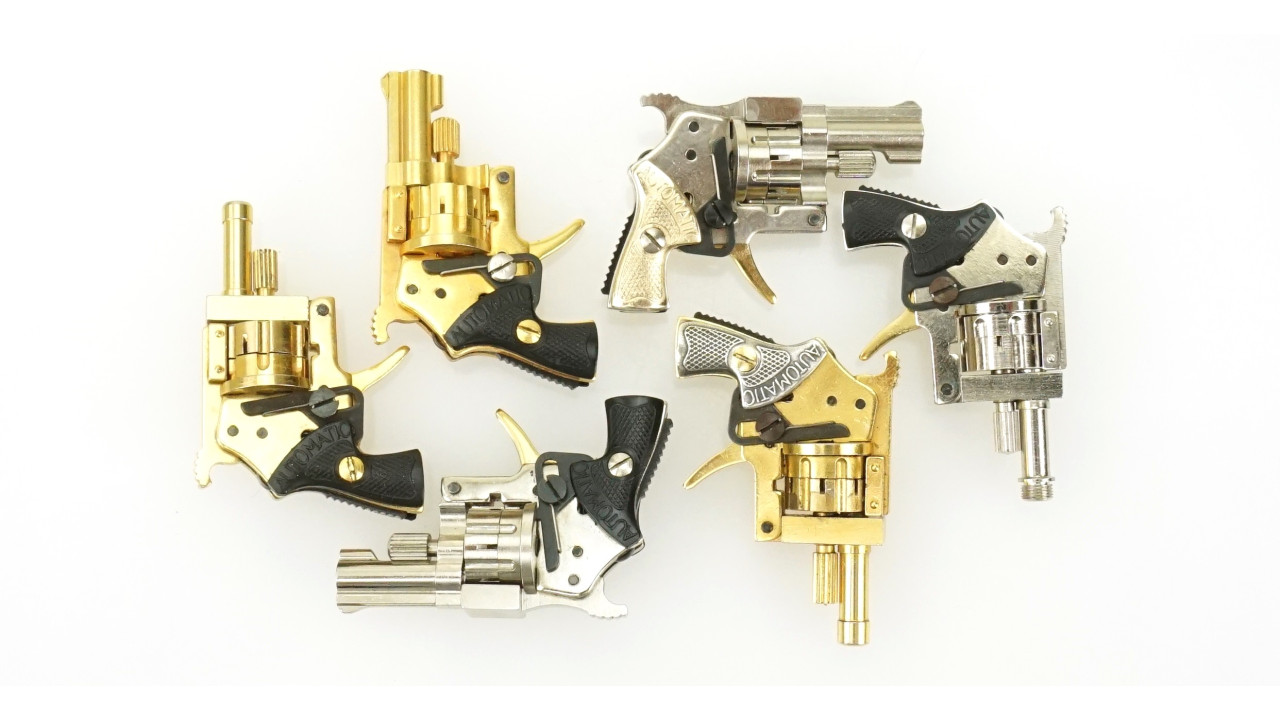
The Xythos miniature pinfire gun occupies a different place in miniature history from the classic Berloque charm pistol. Its familiar form is that of a tiny revolver, complete with a compact grip and visible cylinder, rather than the simpler single-shot watch-fob outline.
For collectors, Xythos is interesting as a later Austrian-associated chapter in the 2mm pinfire story: an object that combines a recognizable revolver shape with the tradition of miniature mechanical design.
What is a Xythos miniature?
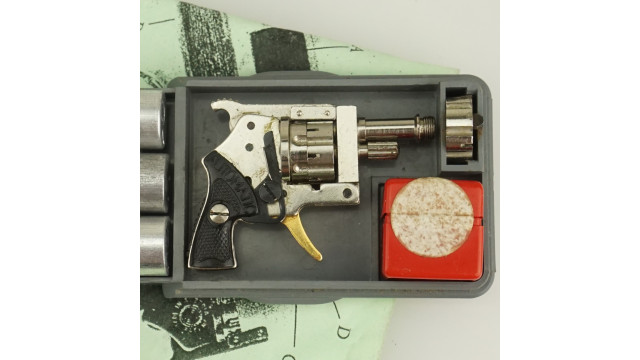
In collector usage, the term Xythos generally refers to a miniature revolver-style pinfire model associated with Austrian manufacture. Examples frequently have a metal frame, a small cylinder and distinctive grip panels. Different specimens can carry different finishes, markings and accessories.
The term should not be treated as a blanket description of every miniature 2mm revolver. Nor should all objects resembling a Xythos be assumed to share one maker, production year or capability. A faithful non-firing replica, for instance, can resemble an original working miniature very closely.
A documented connection to Austria
The Miniature Engineering Craftsmanship Museum describes the original Xythos as a small pinfire pistol made in Austria. Its collection contains a particularly revealing object: a non-firing Xythos replica made in 1968 by Geof Spehar.
Spehar copied a real Xythos borrowed from a friend and reproduced details such as the six-chamber appearance and mechanical movement. The museum explicitly distinguishes the model from the original because the replica was not designed to fire.
This record establishes that the Xythos design was already known to a skilled hobbyist by 1968. It does not, on its own, establish the year the first commercial Xythos was introduced, and responsible historical writing should leave that question open until stronger factory evidence is available.
Austrian makers and surviving technical documents
Collector discussions identify Andres & Dworsky of Karlstein, Austria, in connection with later miniature pinfire cartridges used with Xythos-style models. Austrian patent records also document Andres & Dworsky OHG as the applicant for a 1974 miniature-pistol patent, published in 1976.
These are valuable clues to the broader Austrian miniature industry. However, a patent for one small pistol design is not automatically proof of the original launch date or manufacturer of every Xythos revolver. Brand histories need to be established from dated packaging, advertisements, patents clearly tied to the particular model, and manufacturer records.
How Xythos differs from the Berloque watch-fob pattern
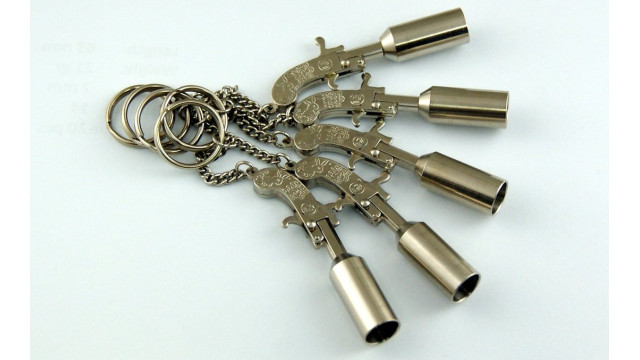
The most immediate distinction is visual. A classic Berloque often has a short single-shot silhouette and curved, engraved grip; a Xythos has the recognizable configuration of a miniature revolver with an exposed cylinder.
That changes the way the object presents itself. The Berloque can look like an elaborate metal charm. The Xythos emphasizes the visual complexity of a revolver design at a dramatically reduced scale.
Other differences may include the shape of the trigger, grip-panel materials, stamped markings, surface finish and form of the presentation case. None of these details, considered alone, is a reliable date stamp.
Historic versions, finishes and sets
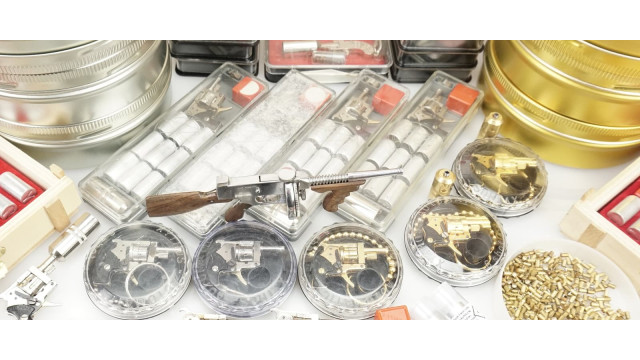
Collectors encounter Xythos miniatures described as plain-metal, gold-colored, pearl-finish and other variants. What these labels actually mean depends on the individual specimen: a decorative color may be plating, a grip overlay or another material treatment.
Some examples survive with original cases or printed paperwork; others are loose pieces with incomplete provenance. A collector's record should describe exactly what accompanies the item and avoid assuming that accessories currently packaged with it were supplied at the time of manufacture.
ThePinfire.com includes Xythos miniature 2mm listings, including a boxed version and a pearl-edition example. Those contemporary listings illustrate differences in condition and presentation; their descriptive names should not be used as proof of the historical sequence of factory editions.
Why maker marks and original paperwork matter
Small miniatures offer limited room for inscriptions, yet stamped letters and country-of-origin markings can be among the most important evidence for dating an example. Clear photographs of such marks are more useful than repeating a vague "vintage" description.
Original printed instructions, catalogues or boxes may help identify the exact variant, but loose packaging should be compared carefully with the object. Inherited or mixed collections sometimes contain genuine items placed in later cases.
The aim is not to force every example into a predetermined edition list. It is to describe what is known, what can be seen and what remains unverified.
The place of Xythos in collecting history
The Xythos connects three interests: historic pinfire ignition, Austrian miniature manufacture and scaled-down revolver design. The existence of both original examples and dedicated non-firing replicas is itself evidence of the model's appeal to mechanically minded collectors.
It also illustrates an important collecting principle: similar appearance does not establish identical function, age or origin. A well-documented Xythos is most meaningful when its specific identity is preserved rather than absorbed into the broad label "2mm mini gun."
Quick questions
Where did Xythos miniature revolvers originate? Museum documentation identifies the original Xythos design as Austrian.
Is the Xythos a Berloque? Both belong to the miniature pinfire collecting world, but the familiar Xythos has a revolver-style profile while the classic Berloque watch-fob pistol is a different design tradition.
Can a Xythos replica be non-firing? Yes. The Miniature Engineering Craftsmanship Museum documents a non-firing Xythos replica made in 1968.