Maus Miniature Pinfire Guns: German Origins and Identifying Features
Among historic miniature pinfire objects, Maus is a distinctive name associated with German-made small charm pistols. The German word Maus means mouse-an apt name for a mechanical object whose appeal depends in part on its extraordinarily small scale.
Surviving boxed examples show that Maus was more than a casual descriptive nickname. It appeared as a name on presentation packaging for miniature pinfire pistols, making the label relevant to collectors interested in German manufacturing and European novelty history.
Where Maus fits in miniature-pinfire history
To understand Maus, it helps to start with the broader story. The pinfire cartridge principle was established in the 19th century; late-century craftsmen produced small pinfire revolvers; and Austrian watch-fob designs associated with Franz Pfannl helped bring simple charm pistols to a larger audience around the turn of the 20th century.
German and Japanese makers subsequently produced related small-format novelty pistols. Maus belongs within this broader family of miniature watch-fob or charm-style objects, not necessarily within the original Pfannl workshop's production.
The exact start and end dates of Maus-branded manufacture are not reliably established by the public sources reviewed for this article. Rather than assigning a speculative decade or single factory to every surviving Maus, it is better to examine the evidence attached to each individual piece.
Why the name "Maus" matters
Historical small-pistol branding often used memorable names that emphasized the miniature format. Mouse-related wording served that purpose, and the label MAUS appears on surviving German presentation boxes.
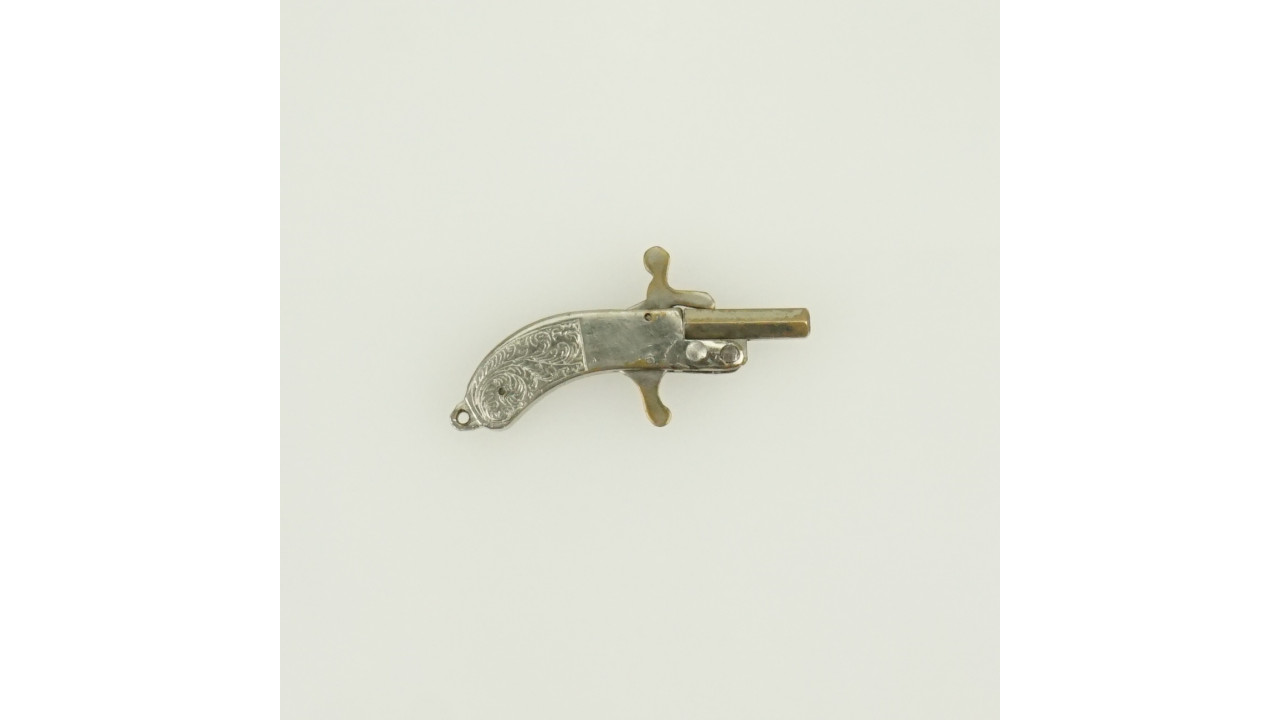
In an archived 2011 collector auction, a German-made Maus miniature pinfire pistol was documented together with its original MAUS-marked box. The description referred to engraved grips and a length of approximately 1½ inches. That is evidence for a particular surviving specimen-not a universal specification for every item ever sold under the name.
Researcher Aaron Newcomer also identifies a German-made Maus miniature and its case in his historical overview of 2mm pinfire guns.
Recognizing the classic Maus appearance
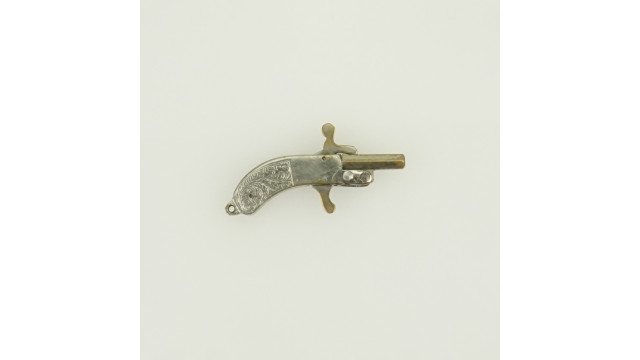
Many Maus-associated objects resemble the small, single-shot watch-fob pistol tradition. Features visible in documented examples include:
- An exceptionally compact pistol-shaped silhouette.
- A short barrel and small metal frame.
- A curved grip, sometimes with engraved or ornamental detailing.
- An attachment loop or other feature associated with a charm or fob.
- On some examples, German origin information and MAUS-branded packaging.
These clues are useful for preliminary classification, but they do not amount to a complete authentication method. A similar shape can be found on Austrian or Japanese miniatures, later reproductions and objects whose makers are unknown.
Country marks, engraving and packaging
The expression "Made in Germany" can offer important evidence when it is genuinely present on the object or demonstrably original packaging. But country marks are not always enough to determine an exact year, especially when designs remained in circulation or were reproduced over time.
Collector documentation is strongest when multiple clues agree: a mark on the metal, a matching box, period instructions, a known catalogue illustration and a traceable ownership history.
Grip engraving is worth recording, too. Decorative motifs may help compare individual examples, but small differences could reflect different manufacturing runs, repairs, surface treatments or entirely separate makers. Without documented reference examples, engraving should not be treated as a guaranteed factory code.
"Maus," "Berloque" and overlapping terminology
Some auction listings describe a Maus as a "Maus Berloque" miniature. That wording reflects how broadly "Berloque" has come to be used for little charm pistols in the collector market.
For historical accuracy, the two terms should not be automatically merged. Berloque is associated with the Austrian watch-fob tradition and Franz Pfannl's early designs; Maus appears as a German-branded miniature name. Their objects can resemble one another without sharing a confirmed manufacturer.
A good catalog entry might therefore say "Maus-branded miniature, German-made, Berloque-style design", if all of those parts can be supported by the specific specimen. That is clearer than claiming a direct family relationship that has not been documented.
What to record in a Maus collection entry
A useful historical record should include the object's measured dimensions, country-of-origin marks, all visible inscriptions, grip pattern, condition, original box details and photographs of each side. It should distinguish directly observed features from claims repeated in sale descriptions.
If an object has no maker marks or matching packaging, describe it cautiously. "Maus-style miniature" may be more accurate than "original Maus" when the attribution is uncertain.
Collectors should also avoid assuming that a piece is inert, safe or legally unrestricted simply because it is small or came in a novelty box. Models and jurisdictions differ; unfamiliar pieces should remain secured and unaltered while their status is assessed.
Why Maus remains interesting
Maus miniatures reveal how a recognizable European design idea moved across borders and acquired new names, packaging and local identities. Their appeal lies in the intersection of German novelty manufacture, decorative miniaturization and surviving collector evidence.
The most valuable contribution a modern collector can make to Maus history is careful documentation: good photographs, exact transcriptions of marks and preservation of original boxes and paperwork. Those details gradually turn scattered novelty objects into a clearer historical record.
Quick questions
What does "Maus" mean? It is German for "mouse" and appears as a name associated with small German-made pinfire charm pistols.
Are Maus and Berloque identical? No. Similar watch-fob styling explains overlapping terms, but individual maker and origin attributions require evidence.
How can I tell when a Maus was made? Use markings, packaging, period documentation and provenance; the brand name alone does not establish a date.